


- Details
- Written by: Администратор
- Category: Этические стандарты
- Hits: 28
Editorial Policy.pdf (download)
Order No. 23-n 30.06.2026 Ed. politics.pdf (download)
Editorial Policy
of the scientific journal "Bulletin of KEU:
Economics, Philosophy, Pedagogy, Jurisprudence"
1. Purpose, Directions of the Journal and Publication Procedure
The journal "Vestnik KEU" is a peer-reviewed, multilingual (Kazakh, English, Russian) and open scientific journal. It reviews previously unpublished scientific articles in the following areas: Economics, Philosophy, Pedagogy, Law. The pages of the journal are open for discussion materials, so its content does not necessarily reflect the point of view of the founders and the editorial board (editorial board).
This guide has been developed in accordance with the editorial policy implemented by the university, based on the order of the Minister of Education and Science of the Republic of Kazakhstan dated January 12, 2016 No. 20 "On approval of the requirements for scientific publications recommended for inclusion in the list of publications for the publication of the results of scientific activity" and the order of the Minister of Education and Science of the Republic of Kazakhstan dated March 31, 2011 No. 127 "Rules for awarding degrees".
The purpose of the journal "Vestnik KEU" is the development of domestic science through the publication and dissemination of the results of scientific research of Kazakhstani and foreign scientists in the declared areas of the journal; research can relate to various theoretical and applied issues of economics, philosophy, pedagogy and law enforcement.
The journal "Vestnik KEU" is published once a quarter (four times a year). When reprinting, a reference to the journal is required. Articles are anonymously peer-reviewed by two reviewers.
The journal's website is installed on the university server and is available at the following link: https://vestnik.keu.kz/index.php/ru/. The archive of journal issues is available at the following link: https://dorm.keu.kz/nii/archive/.
For articles accepted for consideration, the issue of the possibility of their publication is resolved within two weeks. The final decision is made based on the results of the discussion at the Editorial Board. All information about the passage of the article can be obtained by the authors on the journal's website at the link https://dorm.keu.kz/nii/.
The author submits an article and agrees to reproduce free of charge on the Internet on the website of the Karaganda University of Kazpotrebsoyuz in the section "Bulletin of KEU" the electronic version of his article published in the journal "Bulletin of KEU". The author must proceed from the understanding that access to the site is not regulated. It is not permissible to submit plagiarism as an original work and publish a previously published article.
Attention: The author's submission of an article for publication in the "Bulletin of KEU" is automatically perceived as consent to the editorial policy of the journal and the requirements of the ethics of scientific publications.
Articles submitted for publication must comply with the ethics of scientific publications. Authors are responsible for the selection and reliability of the given facts, citations, economic and statistical data, proper names, geographical names and other information, as well as for the use of data not intended for open press. Factual data, all information borrowed from literary and other sources, as well as citations given in the article, must be confirmed by appropriate references. Authors must comply with the requirements for publications.
Rejected articles are not returned to the authors. Payment of fees for publications is not provided.
2. Editorial Council (Editorial Board)
The Editorial Council (Editorial Board) of the journal "Vestnik KEU" consists of the Editor-in-Chief, Deputy Editor-in-Chief, Executive Editor, editors, as well as other domestic and foreign scientists. Members of the Editorial Council (Editorial Board) must comply with the requirements of the State Order of the Ministry of Science and Higher Education of the Republic of Kazakhstan dated January 12, 2016 "On Approval of the Requirements for Scientific Publications Included in the List of Publications for the Publication of the Results of Scientific Activity".
The Editorial Board of the journal "Vestnik KEU" does not support the use of generative artificial intelligence (AI) programs to write sections of the manuscript. Authors using generative AI tools are recommended to follow the guidelines of the Committee on Publication Ethics (COPE). According to the COPE recommendations, authors who use AI tools when writing a manuscript, creating images or graphic elements of the article, as well as when collecting and analyzing data, should disclose information about how and what specific tools were used. This information should be indicated in the methodology and methods section of the manuscript. However, such indication is not required if AI tools were used only to check grammar, spelling or references.
Authors and reviewers should pay attention to the following information when submitting a manuscript or participating in the review process in the online system:
● Registration on the site (name, surname, organization, country, other data specified in the form to be filled);
● Login: login (preferably the surname of the reviewer, one of the authors), password (at least 8 characters);
● Personal account (choice of the role of the author or reviewer);
● Rules for authors (familiarization with the requirements of the journal);
● Sending the manuscript (copy with and without authors), attaching the necessary documents;
● Waiting for a response from the editorial board of the journal.
3. Publication Ethics Requirements
3.1 Ethics of the Editorial Council (Editorial Board)
The editorial board of the journal "Vestnik KEU" in its work is guided by the principles developed by the international association "Committee on Publication Ethics" (COPE, Committee on Publication Ethics) (hereinafter referred to as the Committee), and adheres to the policy of requirements for ethical behavior on the part of authors and reviewers.
In this context, the journal is based on the rules of the Committee, striving to comply with the general principles of ethical research. Researchers should familiarize themselves with this policy and comply with ethical norms and rules in their work. Research involving human subjects should be conducted based on the ethical principles set out in the Belmont Report (Ethical Principles and Guidelines for the Protection of the Rights of Subjects of Research).
The Editorial Board strives to suppress all forms of unethical behavior both on its part and on the part of the authors and reviewers. Manuscripts and articles received for publication, but unpublished, cannot be used by the Editorial Board for personal purposes.
The editorial board of the journal does not allow for publication articles rejected by reviewers as inconsistent with the scientific and ethical nature of publications.
The editorial board of the journal necessarily considers all official claims submitted to the editorial board of the journal.
The work of the editorial board of the journal is based on the principles of politeness, transparency, honesty and objectivity.
If the research is conducted with the participation of humans or animals, the authors must obtain appropriate ethical approval from the institutions in which they work and upload the document along with the manuscript. If necessary, the editorial board and reviewers can verify the authenticity of the submitted ethical approvals.
In support of the commitment to originality and integrity, the journal uses the StrikePlagiarism anti-plagiarism system. The application of StrikePlagiarism reinforces the journal's commitment to high standards of academic integrity. All submitted articles are checked for plagiarism through the StrikePlagiarism platform, and the content must be at least 70 % original. This process aims to identify and prevent accidental or intentional plagiarism, as well as to create a scientific environment focused on the dissemination of original and reliable research.
In accordance with the Order of the Minister of Education and Science of the Republic of Kazakhstan dated March 31, 2011 No. 127 "On Approval of the Rules for Awarding Degrees", "the coincidence of the names of regulatory legal acts and official documents, the names of state and other official bodies and organizations, generally accepted terms, definitions and concepts in the relevant field of science, the texts of regulatory legal acts and the works under study is not considered plagiarism, if the volume and nature of their use do not cast doubt on the independence of the completed article. Also, it is not allowed to use technical means and methods to reduce or eliminate the possibility of detecting plagiarism".
3.2 Editorial Responsibilities
3.2.1 The duties of the Editor-in-Chief include:
1. Determination of the responsibilities and activities of the members of the editorial board, editorial council.
2. Formation and approval of the direction and policy of the journal.
3. Quality control of each issue of the journal and approval of its content.
4. Holding meetings with members of the editorial board, editorial council.
5. Resolution of emerging problems.
3.2.2 Responsibilities of the executive editor:
1. Responsibility for the current work of the journal.
2. Checking the submitted manuscripts for plagiarism and for compliance with the requirements of the journal.
3. Preliminary check of manuscripts for compliance with the goals and direction of the journal.
4. Checking the compliance of manuscripts with technical requirements.
5. Making a decision on sending the manuscript for review or rejecting it.
6. Confirmation of registration of authors and reviewers.
7. Selection and appointment of suitable reviewers in accordance with the direction of the submitted manuscripts.
8. Control of review deadlines.
9. Correspondence with reviewers on the issues of articles submitted by the authors.
10. Control over the timing of revision and elimination of comments by the authors.
11. Correspondence with authors, answers to their questions.
12. Solving emerging problems within its competence.
3.2.3. Editors have the right to reject articles that violate legal regulations regarding libel, copyright infringement or plagiarism. In addition, they are obliged to maintain the confidentiality of manuscripts until they are published.
3.3 Author Ethics
The authors are fully responsible for the selection and reliability of the given facts, citations, economic and statistical data, proper names, geographical names and other information, as well as for the use of data not intended for open printing.
Factual data, all information borrowed from literary and other sources, as well as quotes given in the article, must be confirmed by appropriate references.
The authors are fully responsible for the originality of the submitted work. The submission of plagiarism as an original work and the publication of a previously published article are not allowed. Plagiarism is any borrowing of someone else's text without citation, as well as paraphrasing and borrowing ideas (research results) without reference to the author.
Authors are not allowed to publish the same article describing the same research in more than one journal or other publication. Submitting the same article to different journals at the same time is considered a violation of ethics.
Authors have a responsibility to give due recognition to the contributions of other researchers. They should cite sources that have had a significant impact on the shaping of their research. Any information obtained through personal contacts, such as through conversations or correspondence, should not be used or disseminated without the explicit written consent of the author of the original source. Likewise, information obtained through confidential processes, such as manuscript reviews or grant applications, should not be used without the express written permission of the author.
Authorship should be limited to persons who have made a significant contribution to the conception, design, execution, or analysis of the study. All persons who have made a significant contribution should be listed as co-authors. All scientists who have contributed to the study should be authors of the publication. All authors of the publication are equally responsible for its content.
Authors are required to consider the risks associated with the research subjects. If hazardous chemicals, certain procedures, or equipment were used during the study, the author should clearly indicate these risks in the manuscript. If the research was conducted with the participation of animals or humans, the manuscript should contain information that all procedures were in accordance with current legislation and institutional rules, and were approved by the relevant institutional committees. In addition, authors should confirm that they have received informed consent from the participants in the experiment. The confidentiality of personal data should always be respected.
Authors are required to indicate in their manuscript any financial or other significant conflicts of interest that may affect the results of their research and its interpretation. They should also provide information about all sources of financial support for the project.
In cases where the author discovers a significant error or inaccuracy in the published version of his work, he should immediately notify the editor of the journal and cooperate with him to correct or retract the article. If the editor receives notification from a third party about a serious error in the published work, the author should promptly make corrections, if necessary, retract the article or provide data confirming the accuracy of the original.
3.4 Reviewer ethics
A scientist with a sufficient level of professional competence in the reviewed field of science (topic, question, problem) can act as a reviewer. One of the reviewers can be a member of the editorial board (editorial board) of the journal.
The reviewer acts as an independent, anonymous expert for the author, who makes a decision on the compliance of the publication with the requirements of scientific nature and author's ethics.
A manuscript submitted for review is a confidential document and is subject to copyright law, and therefore cannot be used by the reviewer to discuss it with third parties (except for members of the editorial board) or for personal purposes.
If the reviewer considers himself insufficiently competent or biased regarding the content (the author's point of view on the problem) of the reviewed article, he should refuse to review it.
Articles submitted for review should not contain any personal information about its authors, in order to avoid bias from the point of view of the mismatch of ethnic, religious, social or other qualities of the authors and the reviewer, which are not directly related to the content of the work.
3.5 Publication fee
Publication in the scientific journal "Vestnik KEU" is paid, the fee is charged from the authors to cover publishing and other expenses related to maintaining the established requirements and rules for scientific publications. The amount of payment is set annually and depends on the costs incurred by the publishing house.
4. Procedure for reviewing articles received by
to the editorial office of the journal "Vestnik KEU"
Reviewing of manuscripts of scientific articles in the editorial office of the journal "Vestnik KEU" is carried out to maintain a high scientific and theoretical level of the publication and in order to select the most relevant scientific papers.
Peer review (expert evaluation) is carried out by at least 2 independent experts from among the most authoritative scientists cooperating with the editorial board of the journal. One of the reviewers may be a member of the editorial board (editorial board).
The review process is organized by the executive editor.
The Editorial Board keeps records of the submitted manuscripts passing the review procedure.
After the author submits the article, it is checked for compliance with the basic requirements for the design of the publication and for the presence of borrowing (plagiarism).
If the article meets the requirements, two independent reviewers are appointed (in accordance with the scientific direction in which the article is submitted). Reviewing of materials submitted to the editorial board of the journal "Vestnik KEU" is carried out in confidentiality.
In articles sent for review, the author's name and place of work are not indicated (anonymous).
The reviewer must submit an expert opinion within the period agreed with the editorial board, but, as a rule, not exceeding 2 weeks.
Based on the results of the expert evaluation, the reviewer evaluates the work, gives recommendations and makes a conclusion: "Without revision", "For revision", "Elimination of comments", "Reject".
The conclusion is considered by the editor and an appropriate decision is made.
If one or both reviewers make a decision "For revision", "Elimination of comments", then the author is set a deadline in which changes should be made to the article, according to the recommendations of the reviewer. If the author makes the necessary changes within the specified period, the article again goes through the review procedure. After that, a decision is made again.
If both reviewers make a decision "Without revision", the editor makes a decision "Accepted for publication", and the article is transferred to the category of "Accepted articles" and is published in the order of general priority.
In the event that the author does not agree with the decision "For revision", "Elimination of comments" and refuses to make changes to the article, the article is not published.
In the event of disputes over publication, the decision is made by the Editor-in-Chief.
The author can track all movements on the submitted article in the editorial system at the link https://dorm.keu.kz/nii/editor/ by his username and password.
5. Requirements for the form of submission of articles
Scientific articles submitted for publication (including reviews) must correspond to the stated purpose and thematic direction of the journal and meet the following requirements:
Requirements for the text format of articles:
• Microsoft Word text editor;
• Times New Roman font, size 11 (for the main text of the article);
• Single line spacing;
• Margins: top, bottom, right, left – 2 cm each;
• Paragraph indentation – 1 cm.
The volume of the article in the specified format should not be less than 5 pages and should not exceed 10 pages.
Article structure requirements:
1. The title of the article
2. Abstract
3. Keywords (at least 7 words)
4. Introduction
5. Materials and methods
6. Results/Discussion
7. Conclusion
8. Information on financing (if available)
9. References
10. References
To transliterate Kazakh text from Cyrillic to Latin, we recommend using the online converter at https://qazlat.kz. To transliterate Russian text from Cyrillic to of the list of references into Latin: https://translitonline.com/.
Annotation Requirements:
1. The essence of the problem
2. The purpose of the study
5. Research methods used
6. Results and their significance
7. The volume of the abstract is not less than 50 and not more than 300 words.
The mandatory elements of the publication are:
• the UDC index, which should reflect the subject of the article in sufficient detail, Times New Roman, font size 11, followed by paragraph indentation;
• first name (with capital letters) and last name of the author (co-authors) (all letters are uppercase) in Russian, Kazakh and English, Times New Roman, font size 10, italics;
• information about the authors: regalia, place of work of the authors (department, position), contact information (in Russian, Kazakh and English) and e-mail, Times New Roman, 10-point font, italics, then paragraph indentation;
• the title of the article in capital letters, bold (in Russian, Kazakh and English), Times New Roman, font size 11, followed by paragraph indentation;
• the abstract of the article and keywords in Russian, Kazakh and English, Times New Roman, font size 10 (the first is the abstract in the language of the submitted publication);
• Please note: any abbreviations, including the abbreviation, are allowed only in the original language (full transcription must be provided in other language formats);
• the text of the article according to the structure in two-paragraph indents, Times New Roman, font size 11;
• references and references, paragraph indentation, Times New Roman, font size 10.
Article formatting example
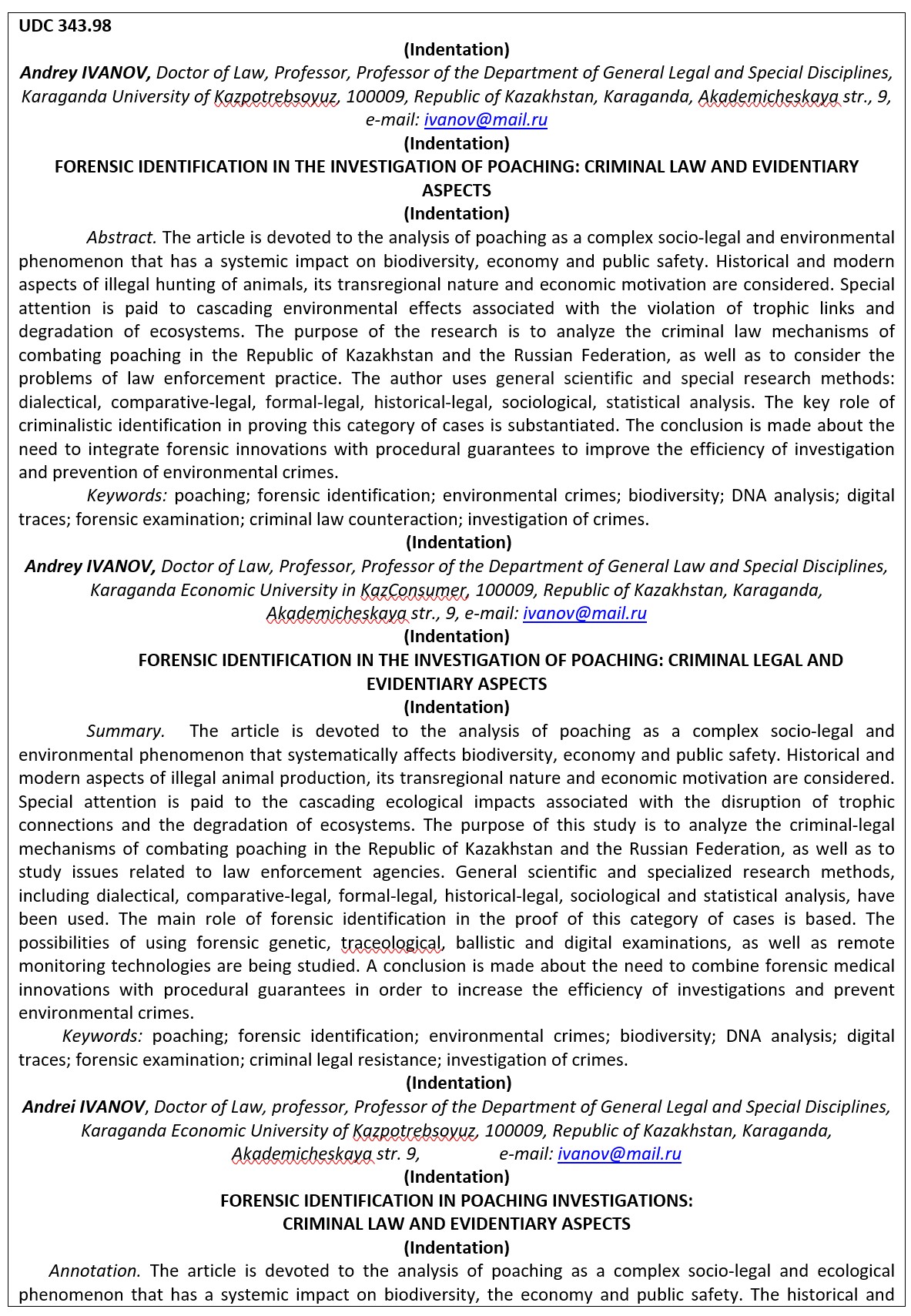
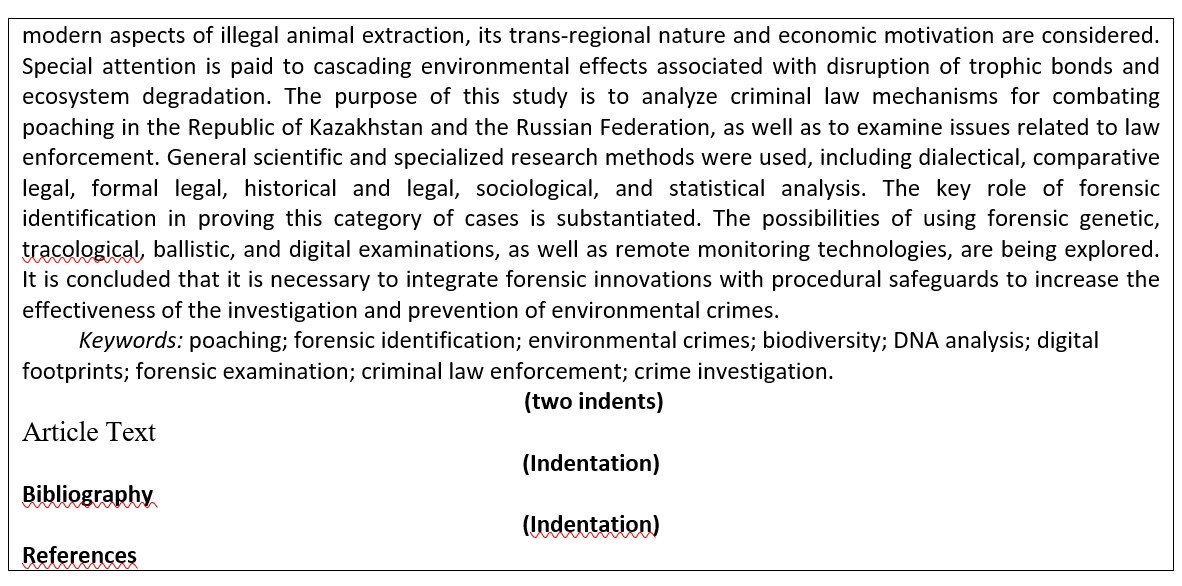
Link design requirements:
A reference to literature is indicated in square brackets, followed by a comma, a non-uppercase «p» dot, and a page number.
See the link design example.
«Further, based on the results of the analysis of plans for thematic areas and plans of faculties, drafts of the plan for the next planned period are drawn up» [22, p.34].
Requirements for the design of illustrations, diagrams and drawings:
All illustrations must have a name and, if necessary, explanatory information (Times New Roman 10-point caption); all illustrations must be referenced in the text of the article. The word "Drawing", its serial number, name and explanatory data are located directly below the drawing. Illustrations should be numbered in Arabic numerals, end-to-end, Times New Roman, 10-point font. If there is only one drawing, it is not numbered.
Drawings, graphs, diagrams, and illustrations published in publications must comply with the requirements of state standards.
All illustrations, diagrams, and drawings should only be in black and white and attached to the text.
See an example of the design of illustrations, diagrams, and drawings.
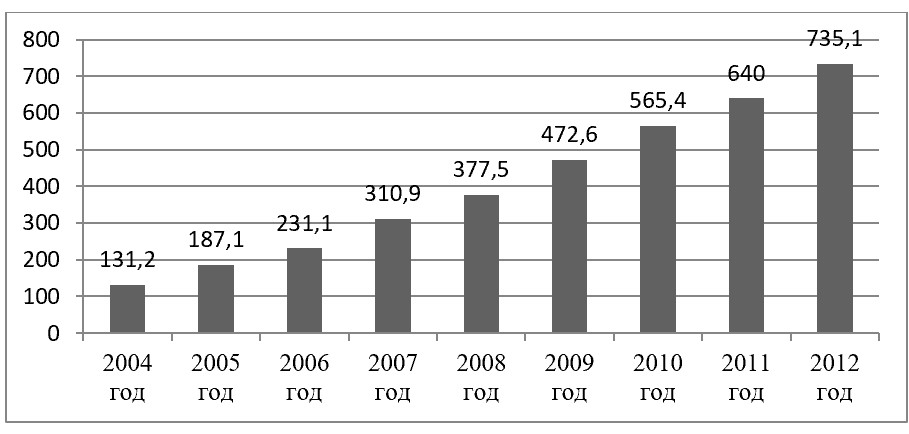
Figure 7 – Dynamics of healthcare costs in Kazakhstan
Note – Compiled by the author according to [5,9,12]
Requirements for the design of tables:
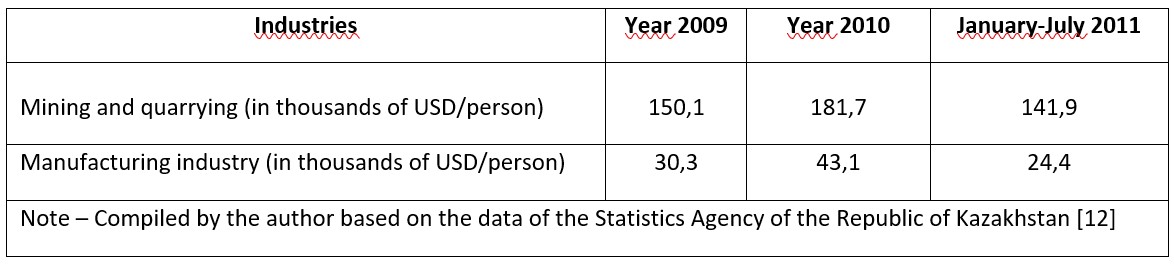
All tables must have a name (Times New Roman, font size10) and links in the text. The name should reflect the content, be precise and concise, and be placed above the table.
The table should be placed immediately after the paragraph in which it is mentioned for the first time. A table with a large number of rows can be moved to another page.
Graph headings are usually written parallel to the rows of the table; if necessary, the perpendicular arrangement of graph headings is allowed. Data inside the table: Times New Roman, font size10.
All tables should be attached to the text.
See an example of the design of tables
Table 1 – Labor productivity data in the extractive and manufacturing industries of Kazakhstan
Requirements for the design of the list of references and References:
The reference list should be presented as a separate section in accordance with ГОСТ Р 7.0.5–2008 / ГОСТ 7.82-2001 edition style in the original language of the cited works. Each source must be properly referenced.
When designing the literature, specify:
• Author (surname and initials in italics) – (Bendina N.V.)
• Name of the source, without quotation marks with capital letters - (Marketing (lecture notes): An exam preparation manual), put a period, a hyphen. The city is indicated after the hyphen, the colon ":" is placed; the publisher is written after the comma; the year of publication is written (– M: Prior, 2000.)
• After the dot and the hyphen, the number of pages is indicated and the letter "p" is placed, followed by a dot (123 p.)
When designing periodicals, the following are indicated
• Author (surname and initials)
• Title of the article, without quotation marks, with capital letters, two slashes //
• The name of the source (magazine, newspaper) with a capital letter, followed by a dot and a dash
• Year of issue (dot, dash), no. (dot, dash), then the pages containing the information (P.1-127.)
• When using information from the Internet, it is indicated: [Electronic resource] and Access mode:
The list of references is given as cited in the article, Times New Roman, font size 10.
See the example of the design of the List of references
1. Tatarkin A.I. Economics of the region on the way of stabilization / ed. by A.I. Tatarkin. – Yekaterinburg: IEUrO RAS, 2002. – 444 p.
2. Puzankov, D.V., Ryabov, V.F., Mamontov, A.N. The System of Strategic Planning of University Development // University Management: Practice and Analysis. – 2002. – No 2(21). – P. 27-36.
3. Law of the Republic of Kazakhstan of January 19, 2011 No 395-IV 3RK "On the status of "Nazarbayev University", "Nazarbayev Intellectual Schools" and "Nazarbayev Foundation" [Elektronnyi resurs] Rezhim dostupa: http://www.kazpravda.kz/_pdf/jan11/260111.
See the design example References
1. Tatarkin A.I. Ekonomika regiona na puti stabilizatsii / edited by A.I. Tatarkina. – Yekaterinburg: Institut ekonomiki Ural'skogo otdeleniya Rossiyskoy Akademii nauk (Russian), 2002. – 444 c.
2. Puzankov D.V., Ryabov V.F., Mamontov A.N. Sistema strategicheskogo planirovaniya razvitiya universiteta [Sistema strategicheskogo planirovaniya razvitiya universiteta]. – 2002. – No. 2(21). – P. 27-36.
Requirements for the form of submission of articles:
The text is provided electronically via the tab (https://dorm.keu.kz/nii/)
The article text must be submitted in electronic format (including a version with author details and an anonymized version for reviewers) via the submission system (http://dorm.keu.kz) by registering and logging in.
Appendix 1
SAMPLE REVIEW FORM SENT TO THE REVIEWER
Add a review
Rate the article and leave detailed comments
Relevance: Relevant
Not relevant
Novelty: Absolutely novel
Relative novelty
Combination of known
Minor innovations
Reliability: Reliability is sufficiently confirmed
Reliability is partially confirmed
Reliability is not confirmed
Significance
Practical Theoretical
Significance: Yes Significance: Yes
No No
Partial Partial
Conformity with direction: Completely
Partial
Does not correspond
Comments/comments
Decision: For revision
No revision
Resolve comments
Reject
- Details
- Written by: Администратор
- Category: Этические стандарты
- Hits: 45
A scientist with a sufficient level of professional competence in the reviewed field of science (topic, question, problem) can act as a reviewer. One of the reviewers can be a member of the editorial board (editorial board) of the journal.
The reviewer acts as an independent, anonymous expert for the author, who makes a decision on the compliance of the publication with the requirements of scientific nature and author's ethics.
A manuscript submitted for review is a confidential document and is subject to copyright law, and therefore cannot be used by the reviewer to discuss it with third parties (except for members of the editorial board) or for personal purposes.
If the reviewer considers himself insufficiently competent or biased regarding the content (the author's point of view on the problem) of the reviewed article, he should refuse to review it.
Articles submitted for review should not contain any personal information about its authors, in order to avoid bias from the point of view of the mismatch of ethnic, religious, social or other qualities of the authors and the reviewer, which are not directly related to the content of the work.
Reviewers should note the following information regarding the online review process:
● Registration on the website https://dorm.keu.kz/nii/ (first name, last name, organization, country, and other details requested in the form);
● System login: username (preferably the reviewer's or one of the authors' last names) and password (minimum 8 characters);
● Personal account (selecting the role of author or reviewer);
● Reviewing the journal's editorial policy (familiarization with journal requirements);
● Completing and submitting the review, and attaching necessary documents;
● Awaiting a response from the author and the journal's editorial team;
● Upon receiving a manuscript marked "For revision" or "Address comments," reviewing the revised version and resubmitting the review.
Procedure for reviewing articles received by
to the editorial office of the journal "Vestnik KEU"
Reviewing of manuscripts of scientific articles in the editorial office of the journal "Vestnik KEU" is carried out to maintain a high scientific and theoretical level of the publication and in order to select the most relevant scientific papers.
Peer review (expert evaluation) is carried out by at least 2 independent experts from among the most authoritative scientists cooperating with the editorial board of the journal. One of the reviewers may be a member of the editorial board (editorial board).
The review process is organized by the executive editor.
The Editorial Board keeps records of the submitted manuscripts passing the review procedure.
After the author submits the article, it is checked for compliance with the basic requirements for the design of the publication and for the presence of borrowing (plagiarism).
If the article meets the requirements, two independent reviewers are appointed (in accordance with the scientific direction in which the article is submitted). Reviewing of materials submitted to the editorial board of the journal "Vestnik KEU" is carried out in confidentiality.
In articles sent for review, the author's name and place of work are not indicated (anonymous).
The reviewer must submit an expert opinion within the period agreed with the editorial board, but, as a rule, not exceeding 2 weeks.
Based on the results of the expert evaluation, the reviewer evaluates the work, gives recommendations and makes a conclusion: "Without revision", "For revision", "Elimination of comments", "Reject".
The conclusion is considered by the editor and an appropriate decision is made.
If one or both reviewers make a decision "For revision", "Elimination of comments", then the author is set a deadline in which changes should be made to the article, according to the recommendations of the reviewer. If the author makes the necessary changes within the specified period, the article again goes through the review procedure. After that, a decision is made again.
If both reviewers make a decision "Without revision", the editor makes a decision "Accepted for publication", and the article is transferred to the category of "Accepted articles" and is published in the order of general priority.
In the event that the author does not agree with the decision "For revision", "Elimination of comments" and refuses to make changes to the article, the article is not published.
In the event of disputes over publication, the decision is made by the Editor-in-Chief.
The author can track all movements on the submitted article in the editorial system at the link https://dorm.keu.kz/nii/editor/ by his username and password.
SAMPLE REVIEW FORM SENT TO THE REVIEWER
Add a review
Rate the article and leave detailed comments
Relevance: Relevant
Not relevant
Novelty: Absolutely novel
Relative novelty
Combination of known
Minor innovations
Reliability: Reliability is sufficiently confirmed
Reliability is partially confirmed
Reliability is not confirmed
Significance
Practical Theoretical
Significance: Yes Significance: Yes
No No
Partial Partial
Conformity with direction: Completely
Partial
Does not correspond
Comments/comments
Decision: For revision
No revision
Resolve comments
Reject
- Details
- Written by: Администратор
- Category: Этические стандарты
- Hits: 1504
The authors are fully responsible for the selection and reliability of the given facts, citations, economic and statistical data, proper names, geographical names and other information, as well as for the use of data not intended for open printing.
Factual data, all information borrowed from literary and other sources, as well as quotes given in the article, must be confirmed by appropriate references.
The authors are fully responsible for the originality of the submitted work. The submission of plagiarism as an original work and the publication of a previously published article are not allowed. Plagiarism is any borrowing of someone else's text without citation, as well as paraphrasing and borrowing ideas (research results) without reference to the author.
Authors are not allowed to publish the same article describing the same research in more than one journal or other publication. Submitting the same article to different journals at the same time is considered a violation of ethics.
Authors have a responsibility to give due recognition to the contributions of other researchers. They should cite sources that have had a significant impact on the shaping of their research. Any information obtained through personal contacts, such as through conversations or correspondence, should not be used or disseminated without the explicit written consent of the author of the original source. Likewise, information obtained through confidential processes, such as manuscript reviews or grant applications, should not be used without the express written permission of the author.
Authorship should be limited to persons who have made a significant contribution to the conception, design, execution, or analysis of the study. All persons who have made a significant contribution should be listed as co-authors. All scientists who have contributed to the study should be authors of the publication. All authors of the publication are equally responsible for its content.
Authors are required to consider the risks associated with the research subjects. If hazardous chemicals, certain procedures, or equipment were used during the study, the author should clearly indicate these risks in the manuscript. If the research was conducted with the participation of animals or humans, the manuscript should contain information that all procedures were in accordance with current legislation and institutional rules, and were approved by the relevant institutional committees. In addition, authors should confirm that they have received informed consent from the participants in the experiment. The confidentiality of personal data should always be respected.
Authors are required to indicate in their manuscript any financial or other significant conflicts of interest that may affect the results of their research and its interpretation. They should also provide information about all sources of financial support for the project.
In cases where the author discovers a significant error or inaccuracy in the published version of his work, he should immediately notify the editor of the journal and cooperate with him to correct or retract the article. If the editor receives notification from a third party about a serious error in the published work, the author should promptly make corrections, if necessary, retract the article or provide data confirming the accuracy of the original.
Authors should pay attention to the following information when submitting a manuscript or participating in the review process in the online system:
● Registration on the site (name, surname, organization, country, other data specified in the form to be filled);
● Login: login (preferably the surname of the reviewer, one of the authors), password (at least 8 characters);
● Personal account (choice of the role of the author or reviewer);
● Reviewing the journal's editorial policy and submission requirements;
● Submitting the manuscript (versions with and without author details) and attaching the necessary documents;
● Awaiting a response from the journal's editorial office;
● Upon receiving a decision of "Revise and Resubmit" or a request to address specific comments: reviewing the reviewer reports, making the necessary corrections, resubmitting the manuscript (versions with and without author details), and attaching the required documents;
● Awaiting a response from the journal's editorial office.
Use of Generative Artificial Intelligence Tools
The journal "Vestnik KEU" editorial board does not support the use of generative AI programs for writing sections of manuscripts. Authors using generative AI tools are encouraged to follow the guidelines of the Committee on Publication Ethics (COPE).
According to COPE guidelines, if authors use AI tools for writing, generating images or graphics, or collecting and analyzing data, they must disclose how AI was used and specify which tools were employed in the methodology section of the manuscript. Authors bear full responsibility for the content of the manuscript, including AI-generated sections. Additionally, AI and AI-assisted technologies should not be listed as authors, as authorship entails responsibilities and obligations that apply only to humans.
A statement regarding the use of AI tools must be included when the manuscript is first submitted. This statement should be provided when uploading the manuscript to the journal’s online system. However, such disclosure is not required for basic tools used for grammar, spelling, or reference checks. If AI tools were not used, no statement is necessary.
- Details
- Written by: Администратор
- Category: Этические стандарты
- Hits: 1781
Requirements for submission:
Please submit all manuscripts to the Editorial Board in Word documents by e-mail:
Master and Bachelor students should attach:
- a scanned version of the scientific Supervisor's recommendation for manuscript submission.
|
Recommendation of the scientific supervisor Title of the paper ____________________________________________________________________________________________ __________________________________________________________________________________________________ Master’s Degree student ____________________________________________________________________________________________ (Family name, name) (year of study, Chair) is recommended for publication by the supervisor ____________________________________________________________________________________________ Signature of the scientific supervisor ______________________________ / / |
• a scanned version of the review from the specialist in this area of research. The review should contain reviewer's scientific degree and contact information (for teaching staff, scientific researchers working in educational and research institutions in Kazakhstan, and other countries).
Results of the manuscript reviewingFamily name, name of the author ___________________________________________________________________________________ Title of the manuscript ___________________________________________________________________________________ ___________________________________________________________________________________ Family name, name of the reviewer ___________________________________________________________________________________ Scientific degree, place of work of the reviewer ___________________________________________________________________________________ Tel. / e-mail of the reviewer ___________________________________________________________________________________ Conclusion of the reviewer: ¾ Accept for publication ¾ Reject Comments I ask you to accept / reject the manuscript because: ____________________________________________________________________________________ ____________________________________________________________________________________ ____________________________________________________________________________________ ____________________________________________________________________________________ ____________________________________________________________________________________ ____________________________________________________________________________________ __________________________________________________________________________________ Reviewer signature ________________________ /........................../ «______» _________________200___. |
- Details
- Written by: Администратор
- Category: Этические стандарты
- Hits: 1090
Editorial Board’s Ethics:
• The editorial board of the journal “KEU Bulletin” in its work is guided by the principles developed by the international association “Committee on Publication Ethics” (COPE), and adheres to a policy of ethical behavior requirements by authors and reviewers.
• Received for publication, but unpublished manuscripts and articles cannot be used by the members of editorial board for personal purposes;
• The editors of the journal are aimed to suppress all forms of unethical behavior both on their part and on the part of authors and reviewers.
• The editors of the journal do not allow publish articles rejected by reviewers as inappropriate scientific and ethical publications.
• The editorial staff of the journal compulsorily considers all official claims submitted to the journal’s editorial board.
• Editorial board’s work is based on the principles of courtesy, transparency, honesty and objectivity.
Author ethics:
• The authors are fully responsible for the selection and reliability of the facts, quotes, economic and statistical data, proper names, geographical names and other information, as well as for the use of data not intended for open printing.
• Actual data, all information borrowed from scientific literature and other sources, as well as citations given in the article, must be confirmed by appropriate links.
• Authors are fully responsible for the originality of the paper provided. Representation of plagiarism as an original work and publication of a previously published articles are not permissible. Plagiarism is any borrowing of someone else’s text without quoting, as well as paraphrasing and borrowing ideas (research results) without reference to the author.
• The authors of the publication should be all the scientists who contributed to the research. All authors of the publication are equally responsible for its content.
Reviewer Ethics:
• Only an independent scientist with a sufficient level of professional competence in the peer-reviewed field of science (topic, question, problem) and not a member of the editorial board of the journal can act as a reviewer.
• The reviewer acts as an independent expert deciding whether the publication complies with the requirements of science and copyright ethics.
• The manuscript submitted for review is a confidential document and falls under copyright law, and therefore cannot be used by the reviewer to discuss it with third parties (with the exception of members of the editorial board) or for personal purposes.
• If the reviewer considers himself (herself) insufficiently competent or biased with respect to the content (the author’s point of view on the problem) of the reviewed article, he (she) should refuse to review it.
• Articles submitted for review should not contain any personal information about its authors in order to avoid bias in terms of discrepancy of ethnic, religious, social or other qualities of authors and reviewer, not directly related to the content of the work.